Who we worked with
Reserve Bank of Fiji
What we’re working on together
Fiji Innovation Hub
The opportunity
Fiji has ambition and a vision for how to grow the economy through local innovation.
There is growing recognition that innovation is not optional, it is central to economic resilience, inclusion and long-term growth. This is well understood by the Reserve Bank of Fiji and all of the partners who have been so important in the establishment of the Fiji Innovation Hub.
Our earlier ecosystem conversations revealed something important: Fiji’s startup and tech community was emerging, but fragmented. There was talent. There was energy. There were willing regulators. But there wasn’t yet a structured ignition point – a place where people could safely step into entrepreneurship and try.
Through the Fiji Innovation Hub partnership, Creative HQ and the Reserve Bank of Fiji set out to create that moment.
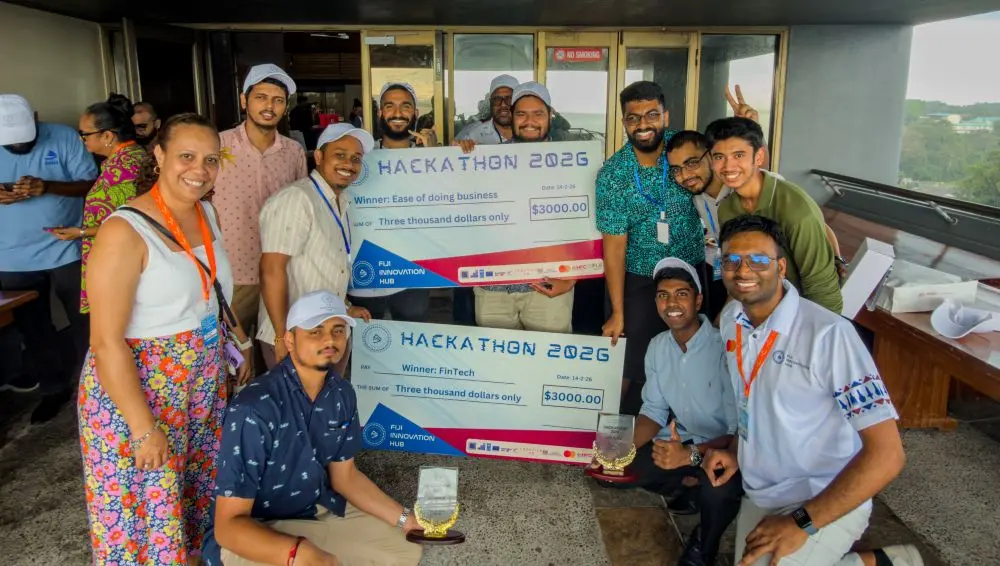
One of the key activities in our first year has been the Fiji Innovation Hub Hackathon, held 12–14 February 2026.
Our approach
We designed the Hackathon as a deliberate ecosystem intervention to show that entrepreneurship can be accessible for everyone and that you will be supported on the journey.
Hosted at the Reserve Bank of Fiji (home to the physical Fiji Innovation Hub launching in April 2026), the event brought together 65 entrepreneurs, students, public servants and innovators from across the country — including participants who travelled by two-day boat from the outer island of Matuku and one who flew in from Perth. Everyone who showed up on day one stayed through to the final day.
Structured around real problems
Teams formed around three themes:
- Fintech (sponsored by Mastercard)
- Sustainability (sponsored by the Ministry of Commerce and Business Development)
- Ease of Doing Business (sponsored by HFC Bank)
Rather than open-ended idea generation, participants converged around research-backed problem statements designed to reflect real systemic challenges facing Fiji.
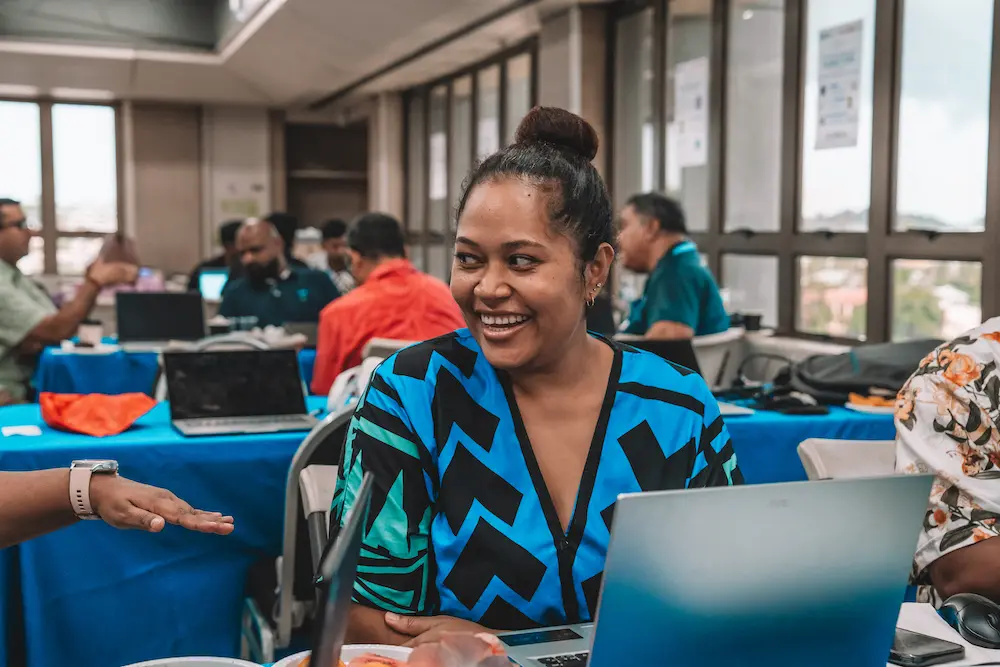
On the first evening, teams were formed. Within hours, they had moved from strangers to collaborators, developing clear problem definitions and solution hypotheses.
Build. Test. Learn. Fast.
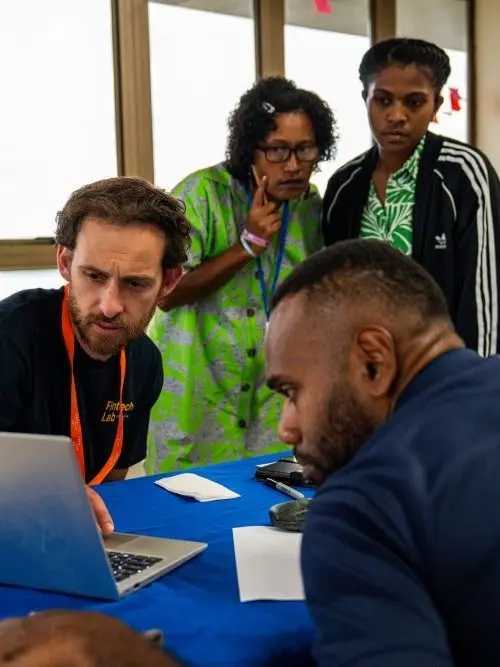
Friday focused on building: through a partnership with Lovable, every participant received $60 in prototyping credits, enabling teams to create working prototypes and test ideas with potential customers by the afternoon. Eight mentors guided teams throughout the 2.5 days, while eight technical and subject-matter experts ran focused drop-in sessions.
Creative HQ embedded innovation methodology into the experience – teaching participants:
- How to craft a solution hypothesis.
- How to use AI tools to accelerate development.
- How to test with real users quickly.
- How to tell a compelling story.
Saturday culminated in final pitches from all 13 teams with judging criteria centred on:
- Problem understanding.
- Solution feasibility.
- Teamwork.
- Execution.
- Creativity and innovation.
Each theme had FJD $5,000 in prize funding, to help develop their concepts further.
Driving impact
The Hackathon was not about producing polished startups in 48 hours. It was about shifting the mindset.
Most participants had never built a prototype before. And no one had ever pitched. Some had never considered entrepreneurship as accessible to them. Our role was to lower the barrier to entry.
We demonstrated that:
- You do not need to quit your job to start exploring an idea.
- You do not need a 40-page business plan to test demand.
- You can build a tangible concept over a couple of days.
- You can test it with real customers immediately.
By combining structured facilitation, embedded mentorship, AI-enabled prototyping, and a safe but high-expectation environment, we created a space where experimentation felt possible.
This is how ecosystems begin to knit together – through shared experience, not just strategy documents.
The result
Measurable impact
- 65 participants
- 13 teams pitched (100% completion rate)
- 30% female participation
- 8 mentors + 8 experts engaged
- 4 media articles ( FBC and Fiji Sun), along with 30+ online posts where participants shared their reflections
- FJD $15,000 in total prize funding awarded
- One team was accepted into an incubation programme within 1.5 weeks
Ecosystem signals
The deeper impact was cultural. Participants were waiting in the lobby before doors opened on Friday morning. Teams stayed late. Conversations continued beyond the event.
Public feedback described the Hackathon as one of the most impactful entrepreneurship events Fiji has seen.
Importantly, the Hackathon seeded momentum for the next stage of the Fiji Innovation Hub journey — feeding into the upcoming Accelerator Programme and strengthening the case for long-term ecosystem investment.
Strengthening the 4Cs of Innovation
At Creative HQ, we believe innovation ecosystems only thrive when four elements are actively developed together: Capital, Capability, Connectivity and Culture.
The Fiji Innovation Hub Hackathon was intentionally designed to strengthen all four.
Capability
Participants learned to frame real problems, develop solution hypotheses, use AI tools to accelerate prototyping, test with real customers, and pitch with clarity and confidence. For many, this was their first exposure to structured innovation practice, with capability that was hands-on and immediately applicable rather than theoretical.
Connectivity
The Hackathon brought together founders and aspiring entrepreneurs, regulators from the Reserve Bank of Fiji, corporates including Mastercard and HFC Bank, development partners and mentors and technical experts. New relationships formed across sectors that don’t normally collaborate directly — the kind of connections that allow ecosystems to begin self-organising.
Culture
Perhaps the most important shift was cultural: entrepreneurship became visible, practical, and accessible. Participants experienced psychological safety to experiment, permission to try without fully committing, and a bias toward action over planning. When people realise they can build and test in a weekend, entrepreneurship stops feeling abstract and starts feeling possible.
Capital
Each theme awarded FJD $5,000 in prize funding, providing immediate support to progress promising ideas. Beyond prize money, the Hackathon created a pipeline toward the upcoming Accelerator Programme — strengthening long-term capital pathways for early-stage ventures.
By intentionally activating all four Cs at once, the Hackathon did more than produce prototypes.
It strengthened the foundations of Fiji’s startup and tech ecosystem. And that is how sustainable innovation villages are built.
We’re nurturing this growing innovation ecosystem
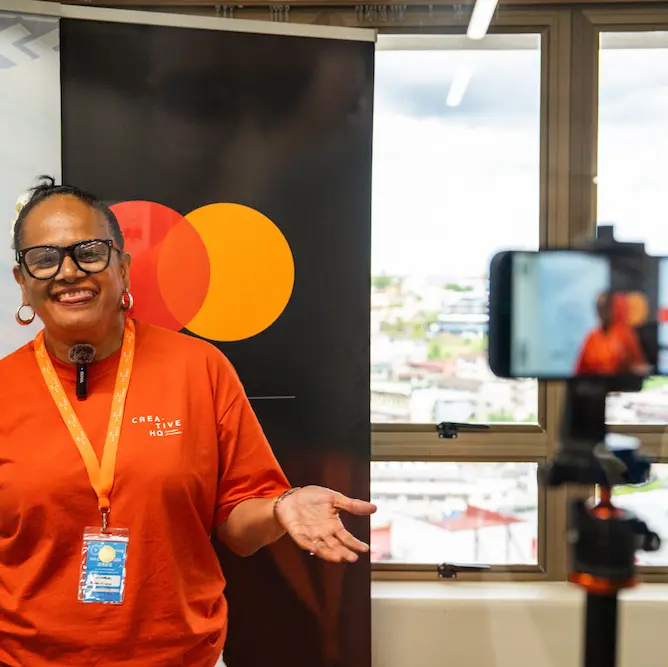
Startups do not emerge in isolation. They grow from networks, shared experience, regulators willing to experiment, corporates willing to engage and mentors generous enough to give their time. The Fiji Innovation Hub Hackathon was more than a weekend event – it showed that Fiji’s startup and tech ecosystem is growing, entrepreneurship is becoming more accessible, and the ecosystem supporting founders is starting to take shape. And there is much more to come.