Creative HQ’s Government Innovation Lead Jonnie Haddon sat down with David Downs, former CEO of New Zealand Story and incoming CEO of Education New Zealand, for a candid conversation about public sector innovation, AI and what it actually takes to change things from the inside.
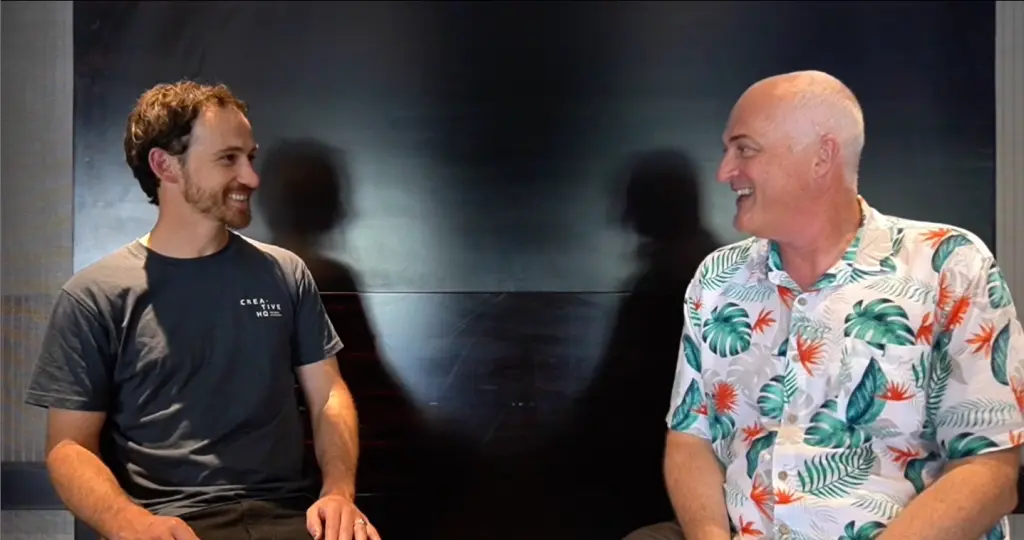
David Downs is something of a rare breed: a tech-background storyteller who’s spent 15 years navigating the public sector without losing his appetite for change. He’s written books on New Zealand innovation, led NZ Story’s global brand effort and is now stepping into the top job at Education New Zealand. When Jonnie Haddon, Creative HQ’s Government Innovation Lead, sat down with him between roles, the conversation covered everything from the myth of government inertia to how leaders should actually be thinking about AI.
Here are the highlights.
The myth of government innovation (and why it’s wrong)
The conversation opened with a provocation. Isn’t “government innovation” an oxymoron? David’s answer was swift: no, and the evidence is overwhelming. The internet, GPS, healthcare systems, ACC / no faults public insurance, many of the world’s most significant innovations came directly from the public sector. The private sector often won’t touch areas where there’s no ROI, which means the government has to be the one to step in.
“The government exists to do things that wouldn’t naturally happen.”
The real problem, David argues, isn’t that the government can’t innovate, it’s the narrative that it shouldn’t try. After 15 years working inside government, he’s gone from a skeptic to a convert: get the best of creative and innovative thinking inside large government organisations and the impact can be enormous.
What it actually takes to push change through
So if the potential is there, what does it take to actually make innovation happen inside a government agency?
David’s answer wasn’t a methodology, it was a personality profile. The people who succeed are tenacious, vision driven and purpose led. They can make a compelling case for where things need to go, they bring stakeholders along and crucially, they build what he calls an authorizing environment: the circle of people (funding bodies, ministers, monitoring agencies) who understand and support the direction.
But at the centre of any real change? An individual, or a small group, who simply believes it’s the right thing to do and refuses to stop pushing.
Sound familiar? It’s how most great innovations happen anywhere.
AI: opportunity, not magic
Jonnie pushed David on AI and to his credit, David didn’t reach for the hype.
He’s been part of the government’s AI expert advisory group, and his take is measured: AI is real, it will enable genuinely new scenarios, but it’s been overhyped in scope. The more useful frame isn’t “AI will transform everything,” it’s a tool that dramatically speeds up the creativity and productivity cycle.
For government specifically, he sees it as:
- A personal productivity engine (getting more done, faster).
- A partner in creativity, helping teams prototype, ideate, and explore new approaches.
- A new interface for how citizens interact with agencies.
And critically, it’s an opportunity for people who’ve historically been shut out of technology’s benefits to actually participate.
Create the sandbox, not the strategy
One of the sharpest moments in the conversation came when Jonnie asked how the government can create environments where experimentation is genuinely allowed, where people aren’t afraid to try things in case they end up on the front page.
David flipped the usual approach on its head.
Most agencies start with a strategy and a policy. David thinks that’s exactly backwards. Start with experimentation. Let people run small prototypes. Learn from what works and what doesn’t. Then build the strategy from the evidence.
He also made a pointed observation: right now, some of the best innovation in agencies is probably happening quietly, people running skunkworks projects with Claude or ChatGPT on the side, half worried the IT department will find out. Leaders need to make that behaviour official, not penalised. Give people permission to experiment in sandboxes, then create the structures to capture and share those learnings across agencies.
From NZ Story to Education NZ: the same story, zoomed in
The last part of the conversation shifted to David’s next chapter. After years telling New Zealand’s story to the world at NZ Story, he’s now heading to Education New Zealand, a more focused brief, but the same underlying logic.
New Zealand’s brand is genuinely strong. We consistently rank in the global top tier for trustworthiness, low corruption, ease of business and desirability as a place to live. In a world that feels increasingly volatile and unsafe, that’s not a small thing.
For international education, New Zealand’s old challenges, distance, small size, are increasingly becoming assets. And our universities ranking in the top 100 to 500 globally gives the sector real credibility to build on. The post Covid rebound in international education hasn’t come as fast as hoped, and David sees this as the moment to press New Zealand’s advantage.
The advice for public sector leaders
Jonnie ended with a direct question: what would you tell a public sector leader who wants to create an environment that genuinely embraces innovation and AI?
David’s answer, in order:
- Take it out of the IT department. IT’s job is to manage risk and keep things running, not to be the innovation engine.
- Get personally involved. Not just at a surface level, actually build your own understanding of what these tools can and can’t do. If you as a leader aren’t personally engaged with this stuff, daily and weekly, it won’t happen.
- Encourage bottom-up experimentation. Most real innovation in any agency will come from individuals who can see a better way of doing something. Make it safe for them to try.
- Strategy comes last, not first. Run the experiments. Collect the prototypes. Build the strategy from what you learn, not the other way around.
Want to watch the full conversation? Watch the video here
Creative HQ works with government agencies to build the conditions for innovation, from capability building to hands-on programmes and project delivery. Get in touch to find out more.