Building a Fintech is not your regular startup journey.
You can’t just build something, put it online and start selling. Before your first customer can hand over a cent, you’re navigating financial regulations, licensing requirements, compliance frameworks, and technical infrastructure that would make most founders think twice. And that’s before the product is even user-friendly.
The Fintechs people point to as success stories – your Sharesies, your Airwallexes – didn’t get there in a year. Or three. Those are decade-long journeys, built on layers of trust, regulatory groundwork and relentless iteration. The overnight success narrative doesn’t exist in this industry. What exists is founders who kept going anyway.
Which is why what this cohort has achieved in just twelve months deserves some context. One year in, these five companies are still in the early stages of what will likely be long, hard, genuinely worthwhile journeys. They’ve got working products, real customers and hard-won lessons. They’re not at the destination – they’re building the road.
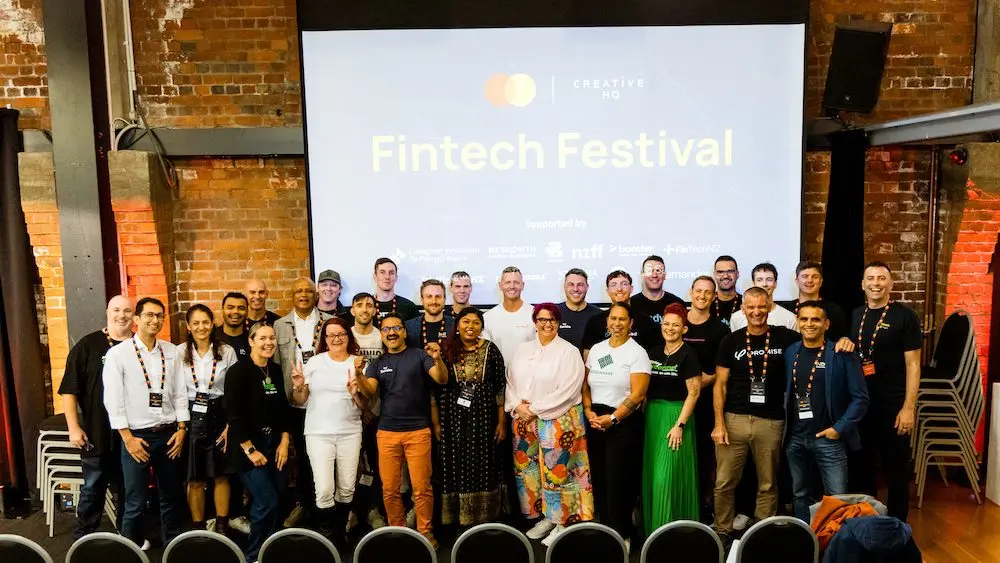
Last year, an inspiring cohort of founders came through Fintech Lab with ideas, energy and varying degrees of “what have I got myself into.”
We caught up with five of them to find out what’s changed, what’s been harder than expected, and what they now know that they wish they’d known from day one.
Thank you to: Campbell from Goldie (fractional precious metals investing), Clive from Sevaka (AI client servicing for KiwiSaver providers), Cam from Paysquad (group payments at checkout), Simon from PolicyCheck (document intelligence for insurance brokers) and Tomas from Otto (making personal finance fun) for sharing your insights!
One year on, here’s what’s happened
Lessons learned: hold onto belief for as long as you can
Ask any early-stage founder what they had in abundance at the start, and the answer is usually the same: belief. But what comes next?
Paysquad’s Cam put it simply: “Right now, you think your energy and excitement will be the secret ingredients — but you’ll find it’s actually your persistence and conviction.” The shift from hype to grind is real, and apparently universal.
Otto’s Tomas is even more direct about the walls you’ll hit: “Everything is harder than expected. One needs a level of sometimes irrational persistence to play this game.”
Sevaka’s Clive wishes he’d spent less time getting comfortable with the problem and more time stress-testing the market: “It’s easy to get conviction around a problem. It’s much harder to validate how strongly the market feels that pain and how quickly they are willing to act.”
The throughline? Belief in your idea matters. But it needs to be backed by real signals – from real customers, in real conversations – as early as possible.
Real insights come from real conversations
If there’s one piece of advice this cohort would shout from a rooftop, it’s this.
Otto’s Tomas: “Talk to people. Don’t build anything without talking to them. Everyone will tell you this. Listen to them.”
PolicyCheck’s Simon put a framework to it — one of Fintech Lab’s hallmarks was pushing teams to run 100 customer interviews in 100 days. “We still refer back to that work constantly,” he says. “It’s become part of our product and go-to-market foundation.”
It sounds obvious. It apparently isn’t. Building ahead of evidence is one of the most common ways early-stage founders lose time – and in fintech, where compliance, trust and switching costs are all high, time lost to the wrong assumptions can be very expensive.
Crossing the chasm
Several founders came into Fintech Lab thinking speed and polish were their main advantages. They’ve all updated that view.
Paysquad’s Cam: “Fintech is one of the few remaining categories where real moats still exist. Regulation, data custody, security requirements, and partner trust create a real barrier. Those constraints slow things down, but they also protect serious builders from AI clones, vibe coders, and shallow copies.”
Sevaka’s Clive puts it more starkly: “In regulated industries, trust is the product. Technology matters. AI capability matters. But what truly drives adoption is whether institutions believe you understand their risk, compliance, and operational realities.”
PolicyCheck’s Simon sees the same dynamic playing out in insurance — an industry he describes as roughly a decade behind banking in technology adoption. Frustrating, yes. But: “that creates a huge opportunity if you can deliver trust, compliance and outcomes.”
For anyone building in Fintech and wondering why it’s slower than a regular SaaS play — this is why. And according to this cohort, that friction is a feature, not a bug.
Could technology be the easy bit?
The challenges that kept this cohort up at night were rarely the technical ones.
For Sevaka’s Clive, it was enterprise sales: “Long cycles, multiple stakeholders, budget constraints, internal politics, procurement layers. It’s far more complex than building the product itself.”
For PolicyCheck’s Simon, it was ruthless prioritisation: “Staying focused on the few activities that actually move the needle — and consistently saying no.” He adds that navigating New Zealand’s funding environment was its own adjustment, particularly coming from Australia.
Goldie’s Campbell names the people challenge: “Finding the right people. Don’t settle for someone because of time or budget constraints. It can cost you more time, money, focus, and amplify the mental burden.”
The technology gets built. It’s everything around it — the sales motion, the team, the focus — that tends to be underestimated.

Looking back on Fintech Lab – how the programme helped these founders
When we asked what Fintech Lab changed, the answers were less about specific skills they picked up.
Campbell from Goldie provided the most expansive view: “Everything except the logo.” Knowledge of the industry, introductions to the right people, a restructured business, and a dramatically more visible brand. Goldie has gone from $1M in trades to $12M since the programme — a number that speaks for itself.
Sevaka’s Clive distilled it to one word: “Energy. There’s something about being in that environment that creates momentum. That energy has carried through well beyond the programme itself.”
For Otto’s Tomas, the most lasting thing was community: “Knowing that there are others in the same boat — fighting similar battles, trying to improve things in their areas, and learning and sharing along the way.”
Paysquad’s Cam: “It gave me a far clearer picture of the future I wanted to build towards.”
And PolicyCheck’s Simon, who has since gone on to complete Blackbird Giants, won the DXC InsurTech 2025 award, and is now working in the orbit of Lloyd’s of London: the programme pushed him to get specific. “That forced a healthier cycle of experiment → feedback → iterate → build, instead of building too far ahead of evidence.”
So, where are they now?
One year on, here’s a quick glimpse:
Goldie has gone from $1M to $12M in trades, with art and collectables on the horizon. Paysquad has grown its merchant footprint by $500M+ and is growing 40% month on month – Campbell describes where they are simply as “the cusp.” Sevaka is now working inside real enterprise environments and has launched a KiwiSaver hardship product that Clive believes will be a significant inflection point.
PolicyCheck is in London, operating in the orbit of Lloyd’s of London. Otto has launched Fortune Fund (a charitable initiative backed by Otto Charitable Trust) and Otto Plus, a subscription tier with some genuinely ambitious tools and games to help people take control of their finances..
All five are still building. None of them are making it sound easy. And all of them, in their own way, say that’s exactly the point.
The best way to stay up to date with these emerging Fintechs? Give them a follow: