Startups are often talked about as if they succeed through talented people alone.
A founder sees a problem. They build something new. They raise capital. They scale.
That’s the version we tend to tell, but it leaves a lot out.
In practice, successful startups are rarely produced by a single person, a single investor, or one well-timed intervention. They grow when the conditions around them are strong enough to help good ideas become investable, resilient, and connected to the markets they need to reach.
That is why Creative HQ’s strategy starts from a simple premise: successful startups need a supportive, thriving ecosystem.
For us, building the ecosystem is part of building startups. You can’t really do one without the other.
Let’s start by looking at this through the lens of Wellington, NZ. We do not lack ideas, talent, smart people, or good intentions. We have founders, public sector proximity, digital capability, creative depth, civic networks and a growing base of climate, fintech, govtech and creative technology ventures. And for the first time, we can put some numbers to that.
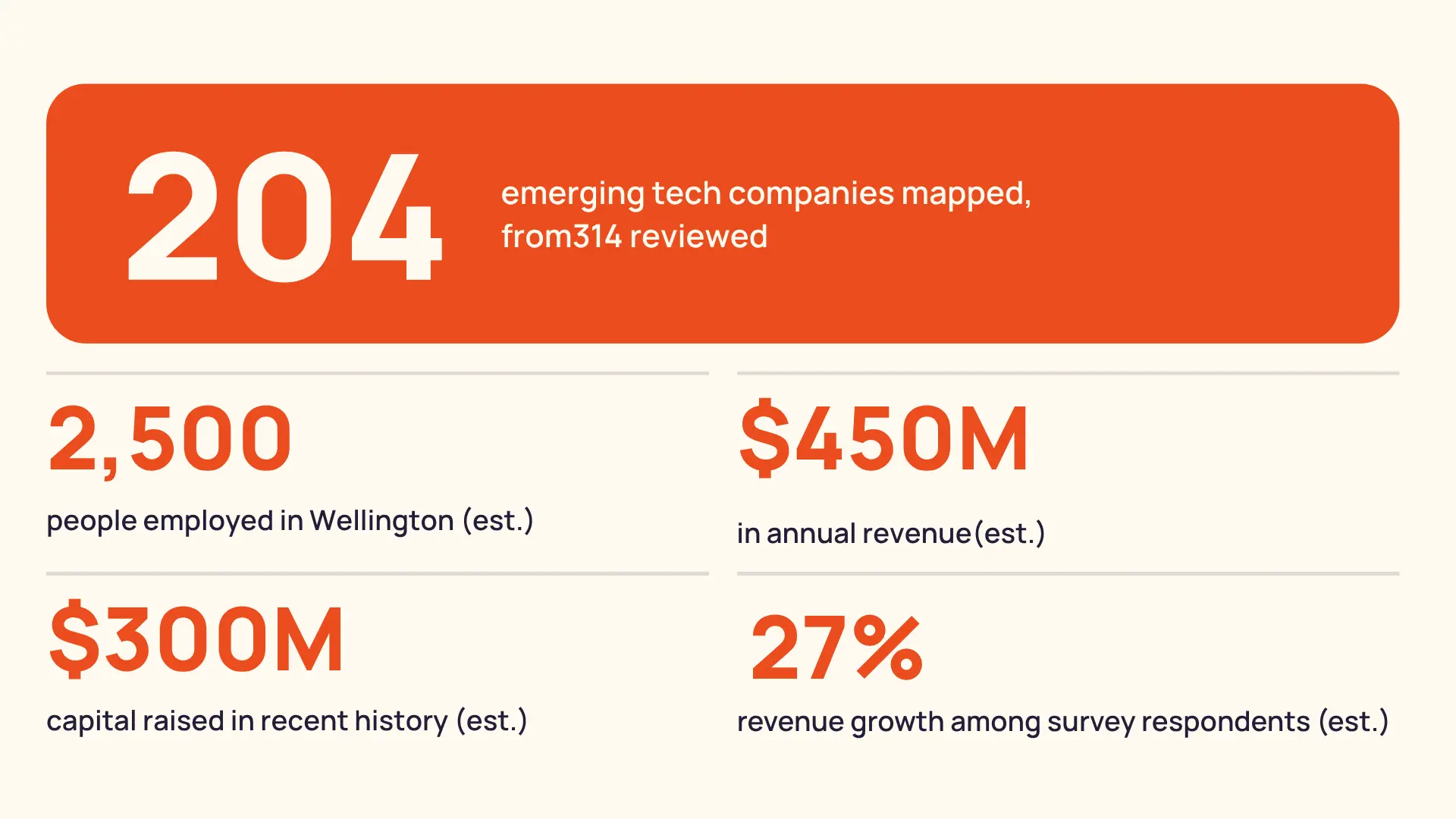
In 2026, Creative HQ worked with WellyForge, Angel HQ, WellingtonNZ, NZGCP, KiwiSaaS and other partners to map Wellington’s emerging tech ecosystem. Of 314 companies reviewed, 204 are product-led tech startups and scale-ups. Together, they employ an estimated 2,500 people in Wellington, generate an estimated $450M in annual revenue and have raised an estimated $300M in capital in recent years.
It is a first glimpse rather than a full census, but it confirms what many of us have long sensed. Plenty is happening. The problem is that a lot of it happens in isolation.
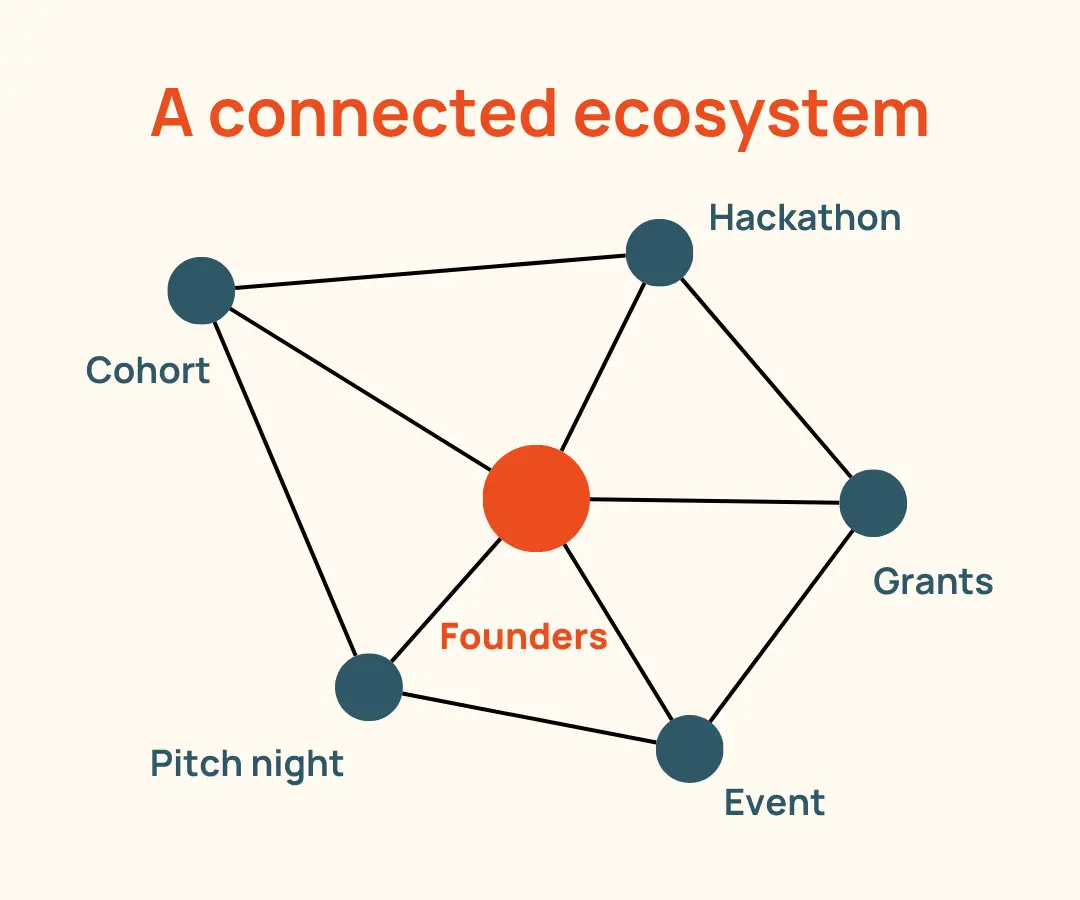
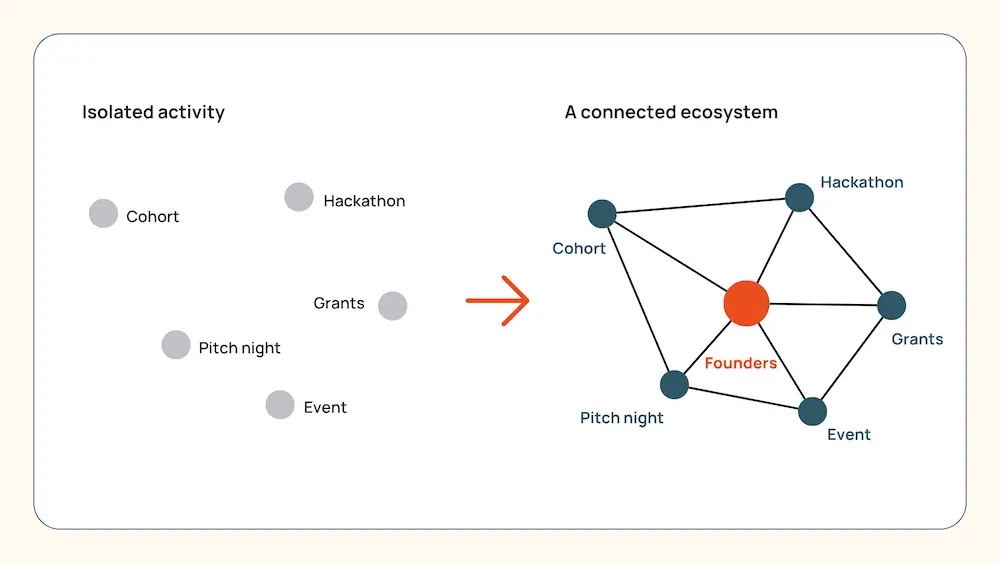
A startup cohort here. A challenge or hackathon there. A showcase of inspiring pitches… a pilot, a grant, a networking event. You get the picture. These things can all be useful. But if they sit in isolation, the value fades once the event ends.
An ecosystem approach asks a different question: what needs to be in place so that more founders can start, survive, scale and contribute back to the economy that helped them get started?
That question has shaped our work in Wellington, and with our partner hubs in Fiji, Queensland, Papua New Guinea and further afield. Working across the startup sector, the public service and private organisations has shown us that ecosystems need to be deliberately built.
Here’s what that means to us.
The ecosystem is the infrastructure
Startup ecosystems are often described through familiar building blocks: capital, capability, connections and culture. That framing is useful, and it is what we align our strategy to, but the real work lies in how those parts are connected, sequenced and sustained over time.
The four Cs only work if they are connected. Capital without capability, for example, just means investors don’t find much worth backing.
Thanks to the recent survey in Wellington, we can now look at how this is being felt through each of these lenses.
- Capital: 66% of surveyed companies say access to capital is holding back their growth. A third have never raised external capital, and bootstrapping is the most common funding route. Only 10 surveyed companies raised $1M or more last financial year.
- Connectedness: Networks matter more as companies mature. 42% of surveyed scale-ups name networks and connections as a key growth lever.
- Capability: Talent is a growth concern for 32% of both validation-stage companies and scale-ups.
- Culture: 77% of surveyed companies have women on their teams, rising to 95% at scale-up. 32% have at least one Māori or Pasifika team member, which is both a foundation to build on and a clear area for focus.
Most regions already have more “ingredients” than they’re aware of. The harder question is whether those ingredients are brought together to collaborate, with a shared vision.
What makes an ecosystem work is mostly invisible: trusted relationships, shared knowledge, people coming back, and resources getting to where they’re needed.
In Wellington, for example, one of our advantages is proximity to government, regulation, policy and public-purpose problems. That should be a strength for founders working in areas like govtech, climate, health, fintech and civic innovation.
But proximity alone is not enough. In the nation’s capital, GovTech/CivicTech is still one of the smallest sectors in the mapped ecosystem, and alongside ClimateTech it faces some of the sharpest capital pressure.
A founder can have a promising solution and still struggle to find a first customer. They can get advice quickly but struggle to move from a good conversation to a pilot. They can complete a programme, pitch well and still face a gap between validation and revenue.
The data backs up what has been felt for a long time. Access to customers and markets is the growth constraint surveyed companies cite most often (73%), ahead of capital. It stays the top priority at every stage, from validation through to scale-up.
Enthusiasm usually isn’t the problem. Where things fall over is the handover between the problem owner, founder, funder, procurement team, investor and customer. Fixing that is what we mean by ecosystem infrastructure.
Creative HQ has been doing this for over 23 years, and we’ve learnt a few things along the way. Here are three lessons from building ecosystems in practice.
1. Ecosystems do not need a single leader – they need orchestration.
The idea that one organisation should “lead” an ecosystem doesn’t hold up. Ecosystems are distributed by nature. They include founders, investors, government agencies, universities, corporates, mentors, community groups and customers.
Trying to centralise that activity usually slows it down.
What is needed instead is orchestration: someone who can see across the system, connect clusters of activity, reduce duplication, and identify gaps.
That isn’t about being in charge. It’s about making it easier for people to find their way around.
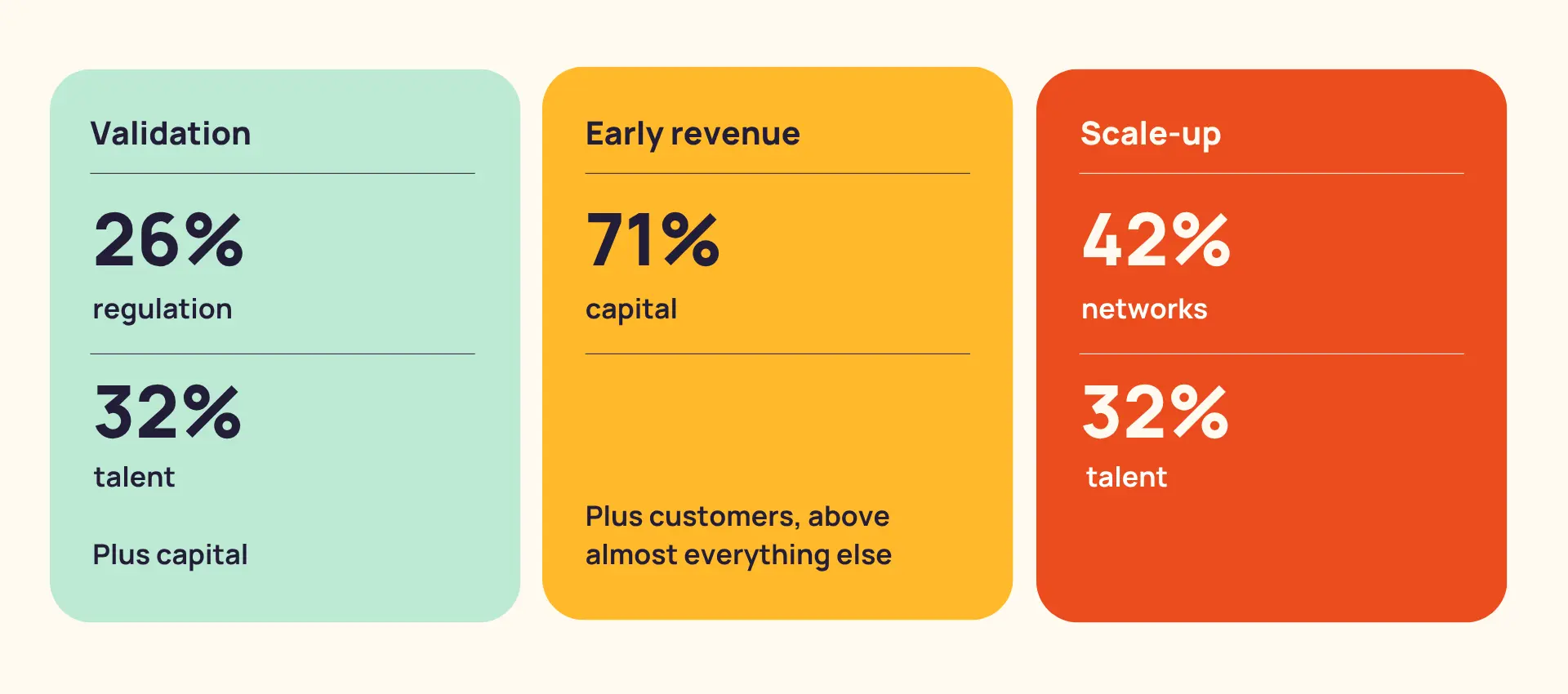
The data shows why. Founders at different stages need quite different things:
- Validation-stage companies are hitting regulation (26%) and talent (32%) alongside capital.
- Early-revenue companies need capital (71%) and customers above almost everything else.
- Scale-ups are constrained by networks (42%) and talent (32%).
No single organisation can meet all three needs well. That is what orchestration is for.
The ecosystem is also regional. Three-quarters of mapped companies are in Wellington City (153 of 204). Lower Hutt is the next most active node with 24, and around 27 more are spread across Upper Hutt, Porirua, Kāpiti and the wider region. Partners like WellyForge, Porirua Biz Hub and Taiawa Tech Hub connect parts of this system that no one organisation could reach alone.
The data behind this piece is itself an example. It exists because partners pooled their company lists and knowledge, and reviewed the framework together.
Good orchestration helps founders understand where to go next. It helps funders see where support is missing. It helps public and private partners avoid duplicating efforts. It helps momentum survive beyond a single funding cycle or event calendar.
It also means being deliberate about the balance between public and private involvement.
Public sector support can create legitimacy, fund early infrastructure, and align activity with broader regional outcomes. Private sector involvement brings market discipline, customers, capital and commercial pathways.
With too much public control, the work can become slow and compliance-heavy. With too little, it can become fragmented and underfunded. A healthy ecosystem needs both.
2. Scale requires a continuous runway, not just a launchpad.
A founder can move through an accelerator, build early confidence, and still face a big gap between initial validation and serious commercial traction.
Wellington’s pipeline has exactly this shape. Of the 204 companies mapped, 77 are at validation, 53 at early revenue and 73 at scale-up. Last financial year, validation and early-revenue companies raised an estimated $21M between them, compared with an estimated $42M for scale-ups.
We are good at starting companies, but we are not yet as good at helping them scale.
Getting this right matters because scale-ups are where the jobs are. Among surveyed companies, 19 scale-ups account for around 79% of Wellington-based employment. And across survey respondents, collective revenue grew an estimated 27% year on year.
That is why ecosystem-building can’t stop at early-stage support. It has to include investor readiness, customer pathways, procurement conversations, talent access, international market connections, and opportunities for founders to keep testing with real users.
We need to help the ecosystem get better at receiving, testing, buying from, and investing in new ventures, not just at teaching founders how to pitch.
This is especially important in Wellington.
As a capital city, we have access to complex public systems and institutional knowledge. That is a real advantage, but if founders cannot turn those problems into clear briefs, pilots, procurement pathways or investment confidence, it stays an advantage on paper only.
The opportunity is to make “capital innovation” practical: clearer problem statements, better market access, stronger customer pathways and more confidence for investors looking at ventures coming out of Wellington.
3. Build from what’s actually here
Ecosystem work tends to fail when places try to copy someone else’s story.
Not every city needs to be the next Silicon Valley. A coastal forest, a wetland and an alpine ecosystem don’t thrive by becoming the same thing. Each works because it suits the conditions it’s in. The same is true for startup communities.
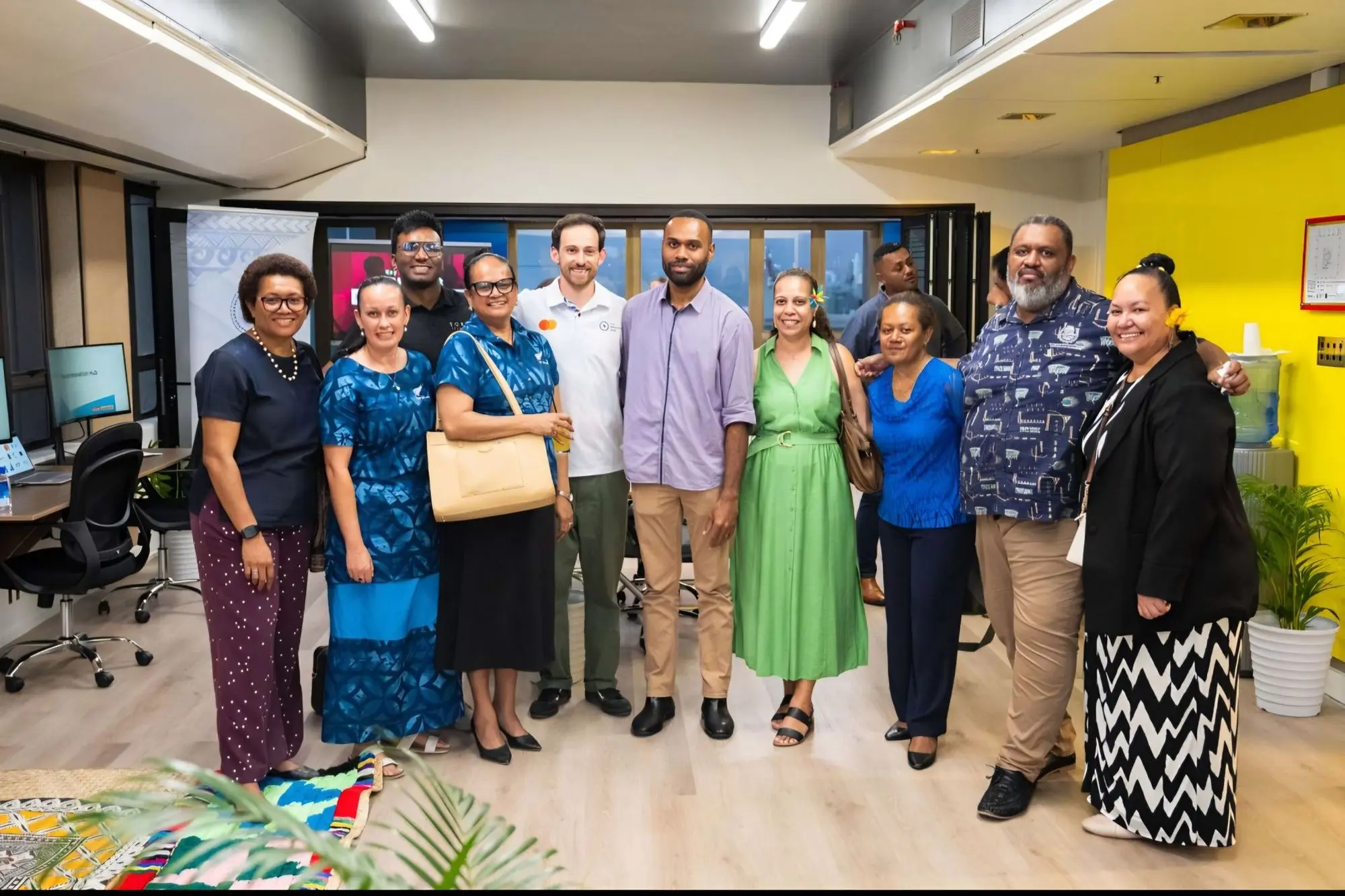
A little over a year ago, Creative HQ supported the Reserve Bank of Fiji to grow Fiji’s economy through innovation, starting with the Fiji Innovation Hub. We drew on what we’ve learnt in Wellington, but tailored it to Fiji. The work needed to reflect the practical realities of island economies, MSMEs, market access and local business support. Likewise, our work in Moreton Bay needs to connect to the region’s industry base and growth ambitions.
In Wellington, we should build from our own strengths. That means taking our concentration of public sector institutions, digital talent, creative capability, climate ambition, civic networks and proximity to national decision-making seriously.
The data shows those strengths are already shaping the ecosystem:
- Engineering roots: Lower Hutt’s cluster of Deep Tech and Hardware/IoT companies reflects its manufacturing and engineering base.
- Creative depth: Among surveyed companies, every Creative Tech/Screen Tech role is based in Wellington (62 of 62).
- Climate ambition: ClimateTech companies have raised an estimated $38M, across a small group of eight companies. It is an early signal, but a promising one.
- Digital talent: SaaS is our largest sector (71 companies, 35%), and 37% of those are AI/ML-first businesses.
It also means being honest about our risks. Capital cities can become inward-looking. Process can crowd out action. Good conversations can be mistaken for progress. Founders can spend too much time circling institutions and not enough time reaching customers.
A good ecosystem plans for those risks rather than pretending they don’t exist.
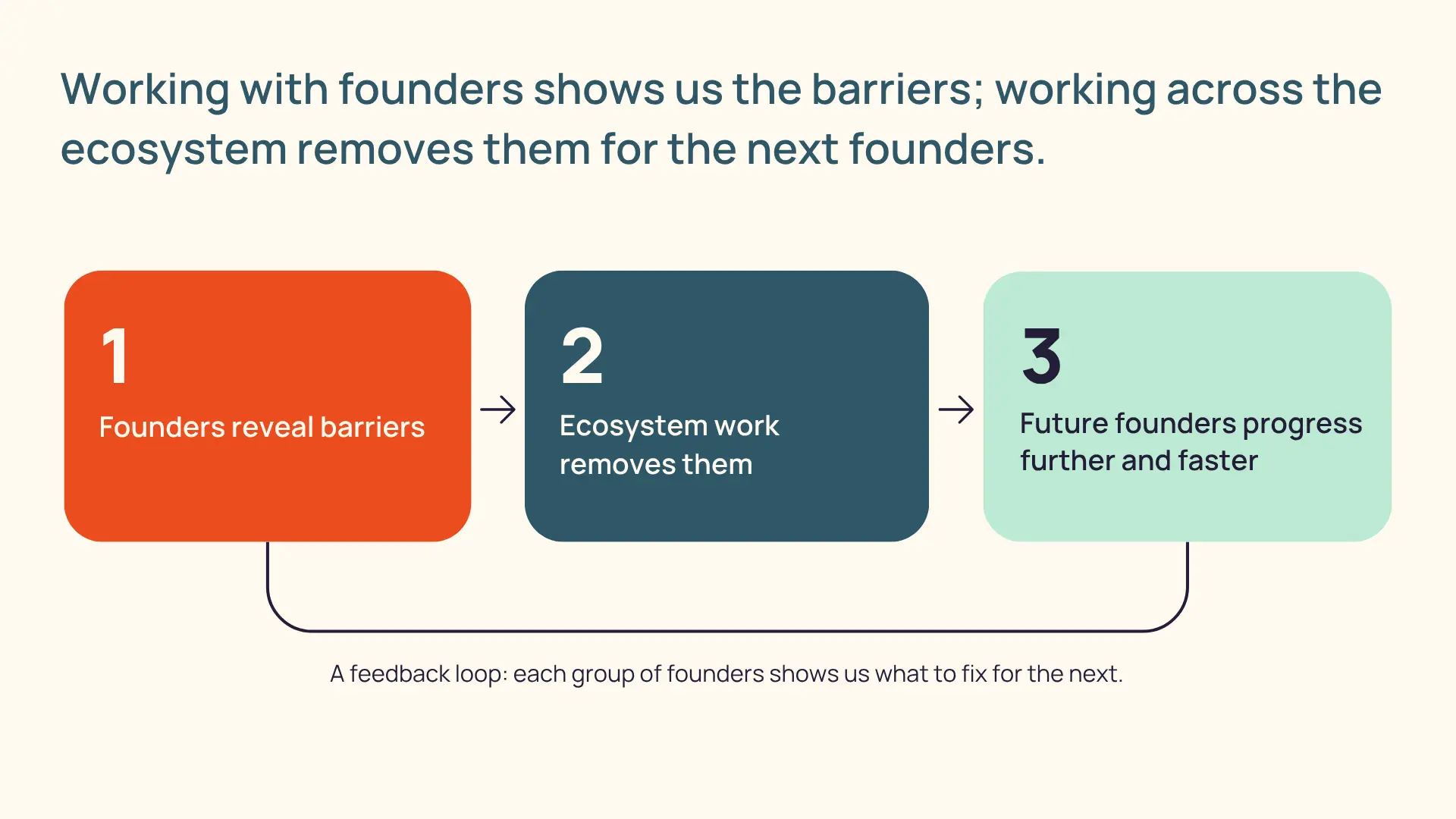
Startup-building and ecosystem-building are one job
Helping individual founders and building the infrastructure around them aren’t separate lines of work. Each feeds the other.
Working directly with founders shows us what is holding them back: a gap in capability, a missing customer pathway, a restrictive procurement setting, a weak capital connection, or a lack of sector-specific support.
Working at the ecosystem level lets us address those barriers for the next group of founders coming through.
The point isn’t more events or more programmes. It’s making it easier for founders to get from one stage to the next.
A few big success stories won’t make a region prosperous on their own. That happens when more people can take part in innovation, more ventures can scale, and more of the economic value stays in the place that helped create it.
This is already happening. Fintech (an estimated $108M raised) and Deep Tech (an estimated $88M) are Wellington’s capital magnets. They are also the sectors most likely to move offshore as they scale. Among surveyed SaaS companies, roughly half of total headcount already sits outside Wellington (183 of 365 FTE based here).
For Wellington, that means being deliberate about the kind of startup ecosystem we want to build: one that plays to our strengths, connects founders to real problems, helps institutions become better customers, and gives good ideas somewhere to go.
And for the first time, we have a baseline to track whether it is working. Repeating this mapping in future years will show whether the scale-up pipeline is growing, whether capital is reaching underrepresented founders, and whether companies are staying in Wellington as they grow.
Not by accident. By design.
About the data
Figures in this piece come from the Wellington Emerging Tech Ecosystem Data Project Report (2026), developed by Creative HQ with ecosystem partners.
This is the first time Wellington’s emerging tech ecosystem has been mapped in this way. It covers 204 startups and scale-ups, 71 of which (35%) completed a voluntary survey. It is a glimpse of the ecosystem rather than a complete picture, but a strong indicator of what many in the sector have long observed.
- Ecosystem-wide figures (jobs, revenue, capital) are estimates. They combine survey responses, third-party validation and stage-based averages.
- Percentages refer to surveyed companies unless stated otherwise.
- The 27% revenue growth figure covers survey respondents only, excluding Serko, whose revenue reflects global listed-company activity.
- Some sector-level findings come from small numbers of companies and should be read as early signals.
- The report is designed as a repeatable baseline, to be refined and tracked over time.
Written by Dr Colin Kennedy
Chief Growth Officer