In Dunedin, a person with a disability can answer their front door more safely and conveniently because of an AI-supported doorstep assistant. Communities around the country are pushing mapping carts through their neighbourhoods, crowdsourcing missing accessibility data – and Easy Read documents (long scattered and hard to find) are getting a mobile-friendly home.
Your standard procurement approach wouldn’t have found these solutions even though they address the very problem they were looking for, so how does a government agency buy solutions it can’t describe yet?
Procurement works brilliantly when you’re building something known. A road, a payroll system, a service with a clear specification: the machinery of tendering and contracting exists for exactly that, and it does the job well.
But it breaks down when the outcome you want has never been delivered before. There’s no specification to write, no market to test it against, no track record to evaluate. Government can easily burn through more money figuring this out than they would by simply partnering with innovators. Whaikaha, the Ministry of Disabled People, understood this. They knew where they wanted to focus: transport, digital and information, the built environment, and emergency management. What they couldn’t have known was what the best solutions looked like, because those ideas sat with Deaf and disabled people, with whānau, and with the organisations who live with these problems every day.
At Creative HQ we’ve worked with New Zealand’s innovators for 23+ years and with just about every government agency – and the gap between them can be a chasm. When the problem is unsolved, traditional procurement isn’t just awkward. It actively filters out the people most likely to hold the answer. That’s the opportunity a challenge-based model is built for.
Together with Whaikaha, we built the Access Activator: an innovation challenge that flips the usual approach. Instead of describing a solution and asking the market to deliver it, we described the impact we wanted and the problem areas, then invited the people closest to it to bring their solutions.
The design considered that innovation in the social impact space means ideas can struggle to progress past an early stage, while also wanting to reward proven innovation to scale impact. So we built two models to address this.
Idea stage
Up to $25,000 for early concepts ready to prototype. These teams didn’t need a working solution yet, just firm logic behind the concept and a plan to test it in the real world. Small money, deliberately. Enough to turn an assumption into evidence. This is the door Intermentis walked through to trial their doorstep assistant. It’s where Veera Access set out to encode the expertise of professional accessibility consultants into a guided, mobile-first assessment tool. And it’s where the Autism Housing Kit Aotearoa came to life, a practical guide for adapting homes for autistic people and tāngata whaitakiwātanga.
Scale stage
Up to $100,000 for solutions that already had proof behind them. These teams had existing products/services and could show it made a difference. The funding wasn’t for starting over. It was for scaling the impact: reaching more people, strengthening what works, and building the case for wider adoption. Access Quest expanding their mapping coverage across New Zealand, Āhei strengthening pathways into adapted sport, and People First NZ building a mobile-friendly platform for Easy Read documents are exactly what this looks like.
We didn’t ask for a traditional proposal or long tender documents, which reward organisations that are good at writing tenders. These can be a barrier for a lot of the community groups we most wanted to hear from. We used a plain-language shorter Q&A style application. Tell us the problem, your idea, your plan, your evidence and your budget.
We had a short sharp delivery window of 3 months. Long enough to test something real. Short enough to keep costs lean.
We’d hoped the format would open the door wider. We had 160 applications.
They came from disabled-led collectives, community groups, Māori organisations and social enterprises, right through to established startups who saw the challenge as a way to point proven capability at problems they cared about. Small teams pairing lived experience with delivery skills sat alongside companies with products already in-market. Plenty of applicants had never applied for government funding before. We found ourselves reading ideas that no tender process would ever have surfaced.
Besides the funding from Whaikaha, the Access Activator also provided the teams with Creative HQ innovation coaching. The weekly coaching sessions gave each team the opportunity to soundboard their ideas, challenge their assumptions and build accountability and momentum.
In the words of one of the programme participants: “The sessions with Nedra (Creative HQ Innovation Coach) were exactly what we needed each Monday, quietly listening to what we had achieved, then asking the right questions and helping us focus on things we would otherwise have let slip.”
By the end of the two-month programme, all six teams delivered the prototypes and products they promised. The programme culminated in a showcase at Creative HQ which provided an opportunity for all six Access Activator teams to present their solutions and to celebrate their journey with the disability community, kaimahi from Whaikaha and the Minister for Disability Issues, Hon Louise Upston.
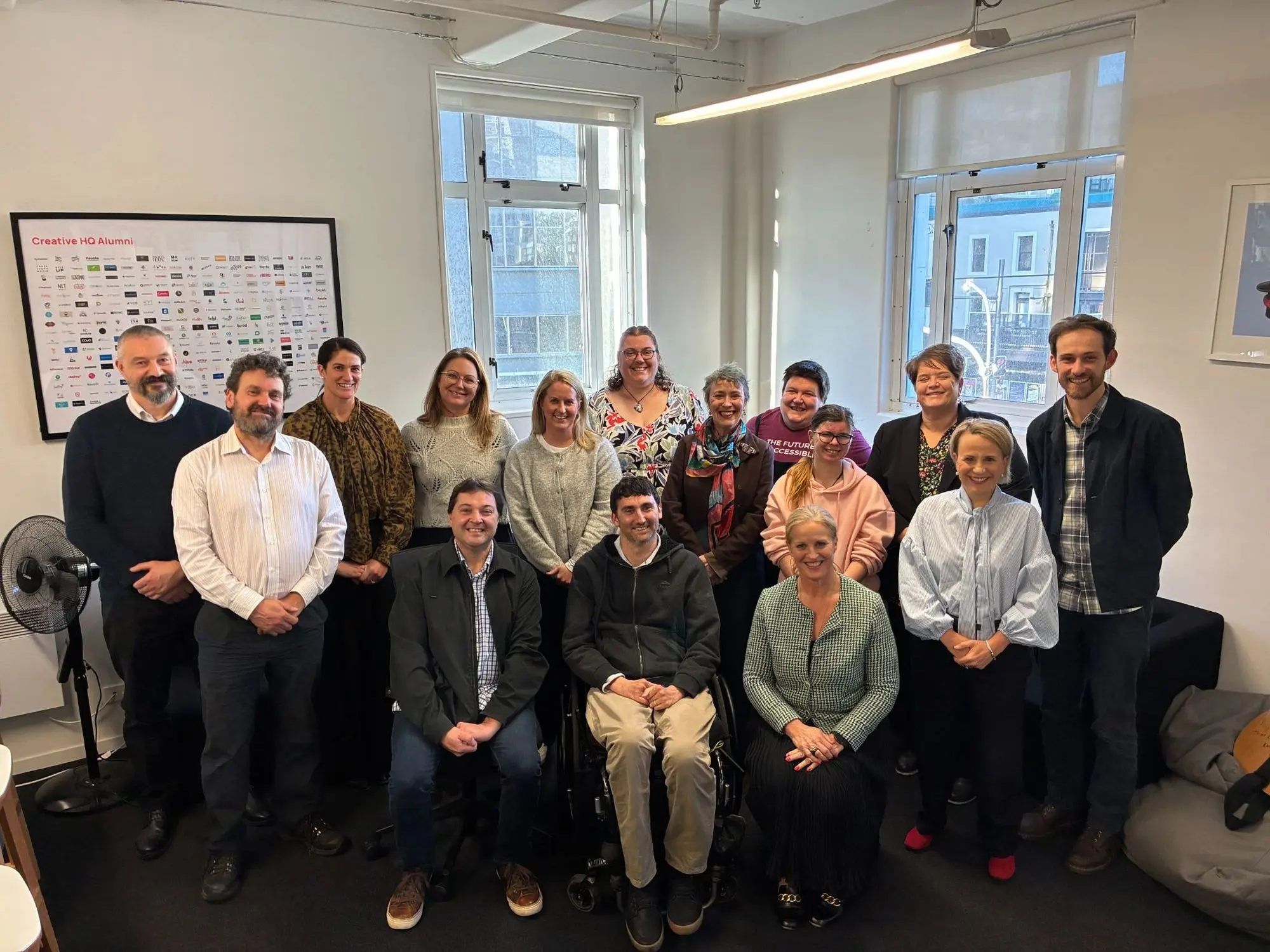
“Today, for me, really brings to life the social model of disability. This programme attracted 160 applications. That extraordinary response told us that New Zealanders care deeply about accessibility. Today we celebrate the six innovative projects that stood out from all of those 160 applications.These projects are all grounded in real world challenges, informed by lived experience and they focus on practical solutions. Congratulations to the six teams. Thank you all for being part of helping us all collectively break down barriers and make a more accessible Aotearoa New Zealand.” – Paula Tesoriero, Whaikaha CEO
The New Zealand Government buys tens of billions of dollars of goods and services every year. Meanwhile, Aotearoa has a startup and innovation community that punches well above its weight. We’ve spent 23 years working alongside it, with a network of more than 20,000 founders and innovators.
Unfortunately, these two worlds don’t generally meet. Programmes like the Access Activator are what it looks like when they do. Procurement will always be the right tool for building what’s known. For everything else, for the solutions nobody has delivered yet, challenge-based models like this one are needed for the government to deliver more impact and explore how they can better use new technology.